Feeds:
Posts
Comments

My Garden Friends

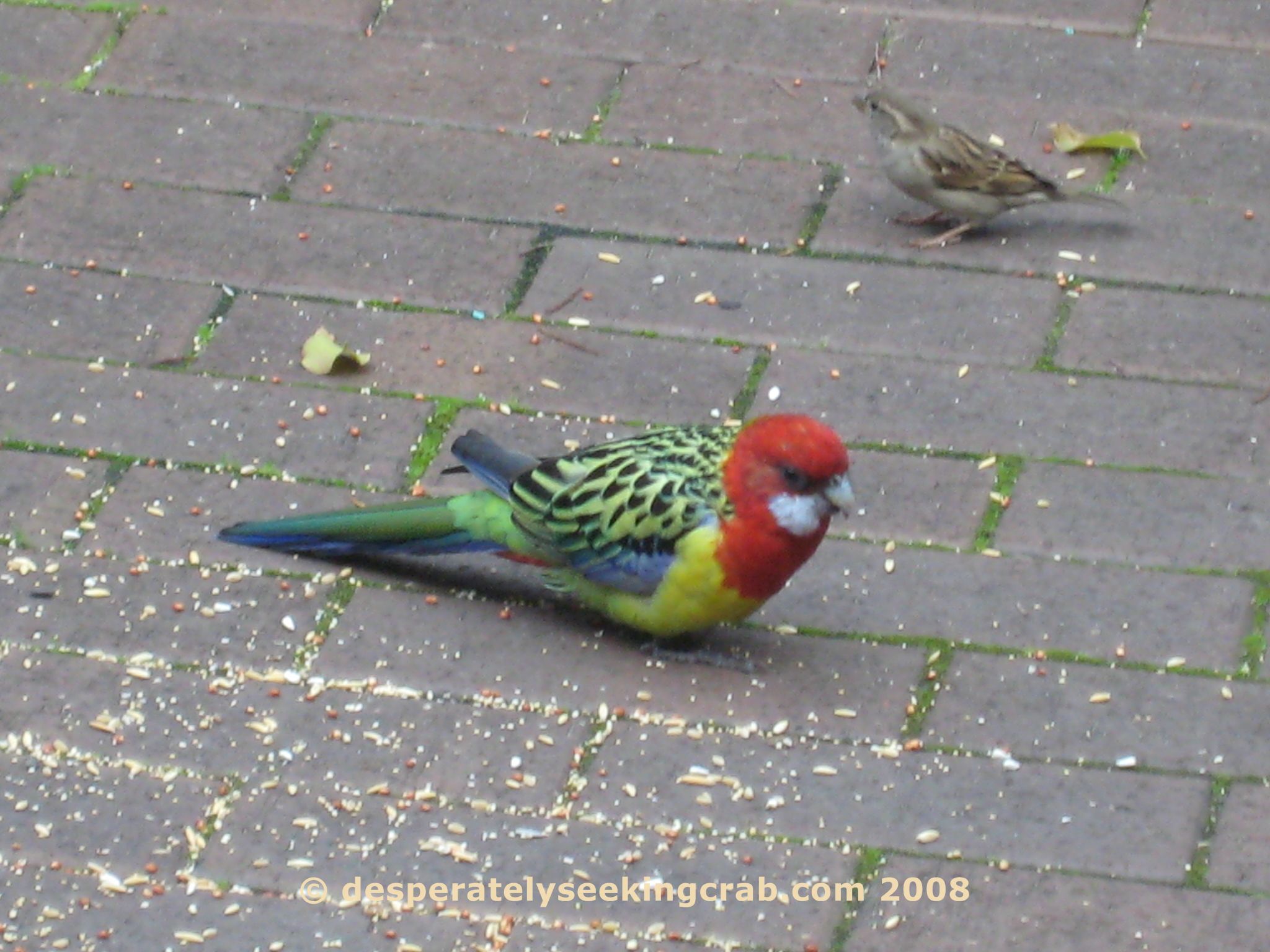
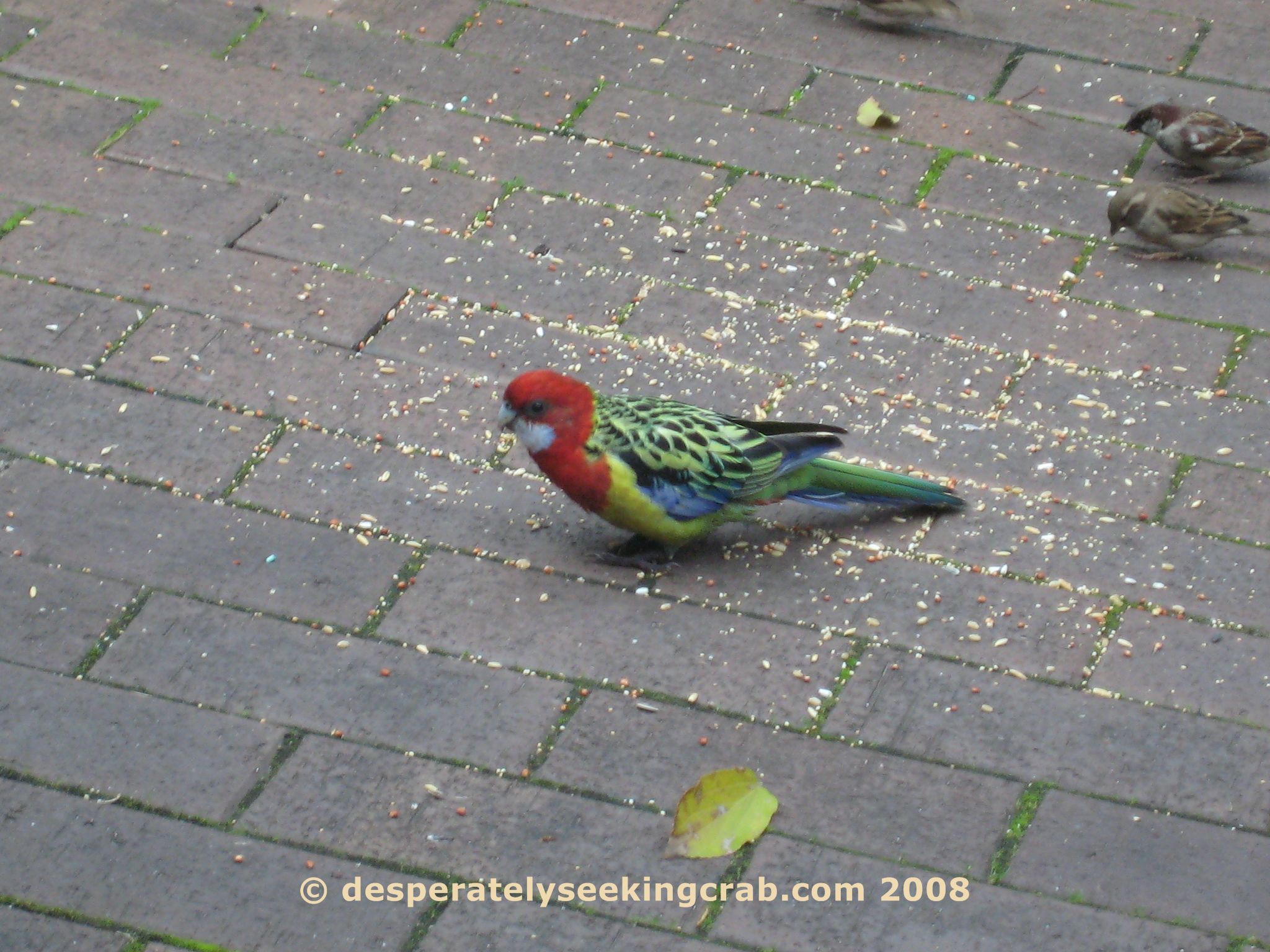
This post isn’t about food but I couldn’t resist sharing these photos.  Winter is a pretty dead time in my garden (plant-wise) but it is the time of year when I put out bird seed and everyday, I get excited by the different varieties of birds that visit me.  The wonderful birds & wildlife is what I love most about Australia.

In my garden, crested pigeons are the most common and so are sparrows but occasionally I get the odd magpies and very very rarely, do I get a parrot species.

Here is the Eastern Rosella (Platycercua eximius) that landed in my garden yesterday (with a few sparrows):

Every Saturday, I thumb through the large “Career One” section of our local paper to see if anything jumps out at me as interesting or worth applying for.  Although winter tends to be a pretty slow time of year for job ads, I have recently (in the last month) found two ads that made me chuckle and left me a bit puzzled.

The thing that I find joy in living here in Australia is the language.  The Aussie slang never ceases to amaze me – there are literally thousands of words and phrases to learn!  It is truly what makes Australian English so different from American English.  Australia’s slang variety and uniqueness is similar to Britain’s variety of regional accents.

“CHICKEN CATCHERS”

What makes me laugh about this ad is not just that they’re asking for chicken catchers but that it’s for the NIGHTSHIFT!!  What!?  Sounds like a job for someone very young and fit to run after chickens in the dark! Someone please explain…I need to be enlightened.

“GLASSY REQUIRED”

This is nowhere near as funny as the ad above but this just shows the Aussie slang.  I am assuming that “glassy” means someone who collects and cleans the mass amounts of glasses that needs to be dealt with on a Friday & Saturday night.  It just seems like such a very particular job position and one that would get pretty dull after a few months.  WTF…I honestly find it odd that they require a resume…how about just a phone call?  Does it need a college degree too?

I LOVE oysters.  This is surprising because I hated them as a kid and when I tried my first raw oyster in the mid-90s (at the London Beer Show) , I got violently ill.  Instead of putting me off of oysters for life, I fell in love with them and even did an in-depth study on oysters and pearls in literature for a senior thesis at university.  No one loves oysters as much as my friend Jacqui, who can knock back more raw oysters than anyone I know.  Jacqui was also the friend who introduced me to some of the best oysters I ever had in my life, straight from Barilla Bay farm near Hobart, Tasmania.  We have gorgeous oysters in South Australia as well, especially from the Eyre Peninsula.  Just remember that oysters tend to spawn in the summer and if you happen to eat them in the summer, you may notice a creamier texture (which I do not like at all).  Most people would agree that they are at their best in the winter.

Japanese Fried Oyster

Japanese Fried Oyster

Deep-frying oysters is also delicious.  In Japanese restaurants you’ll often see it sold as “Oyster Fry” or Kaki Fry” (Kaki has a double meaning of both oyster and persimmon in Japanese).  The recipe is super easy and there is no measuring that needs to be done.

All you need to serve two portions:

– 12 to 16 oysters (depending on whether you are having it as a main or an appetizer)

– plain flour

– 1 to 2 eggs

– Japanese panko breadcrumbs (don’t substitute this)

– salt & pepper

– oil

– cabbage

– tonkatsu sauce  (Tasty Island Blog has a great post on tonkatsu sauce) http://tastyisland.wordpress.com/2008/01/13/tonkatsu-is-all-about-the-sauce/

Directions:

Shred cabbage very thinly by hand or with a mandolin.  Divide between serving plates.  It is meant to be eaten with the fried oysters.

Put raw oysters in a bowl and rinse with cold water (you can use salted water but I don’t think it’s necessary).  If you happen to have some grated daikon handy, you can also use the daikon to “rinse” the oysters and then rinse with cold water.  Pat dry with paper towels or tea towel.  Put about 1/2 cup of flour on one plate, a cup of panko on another plate and beat an egg (w/a couple of tablespoons of water) into a separate bowl. Meanwhile, start to heat the oil.

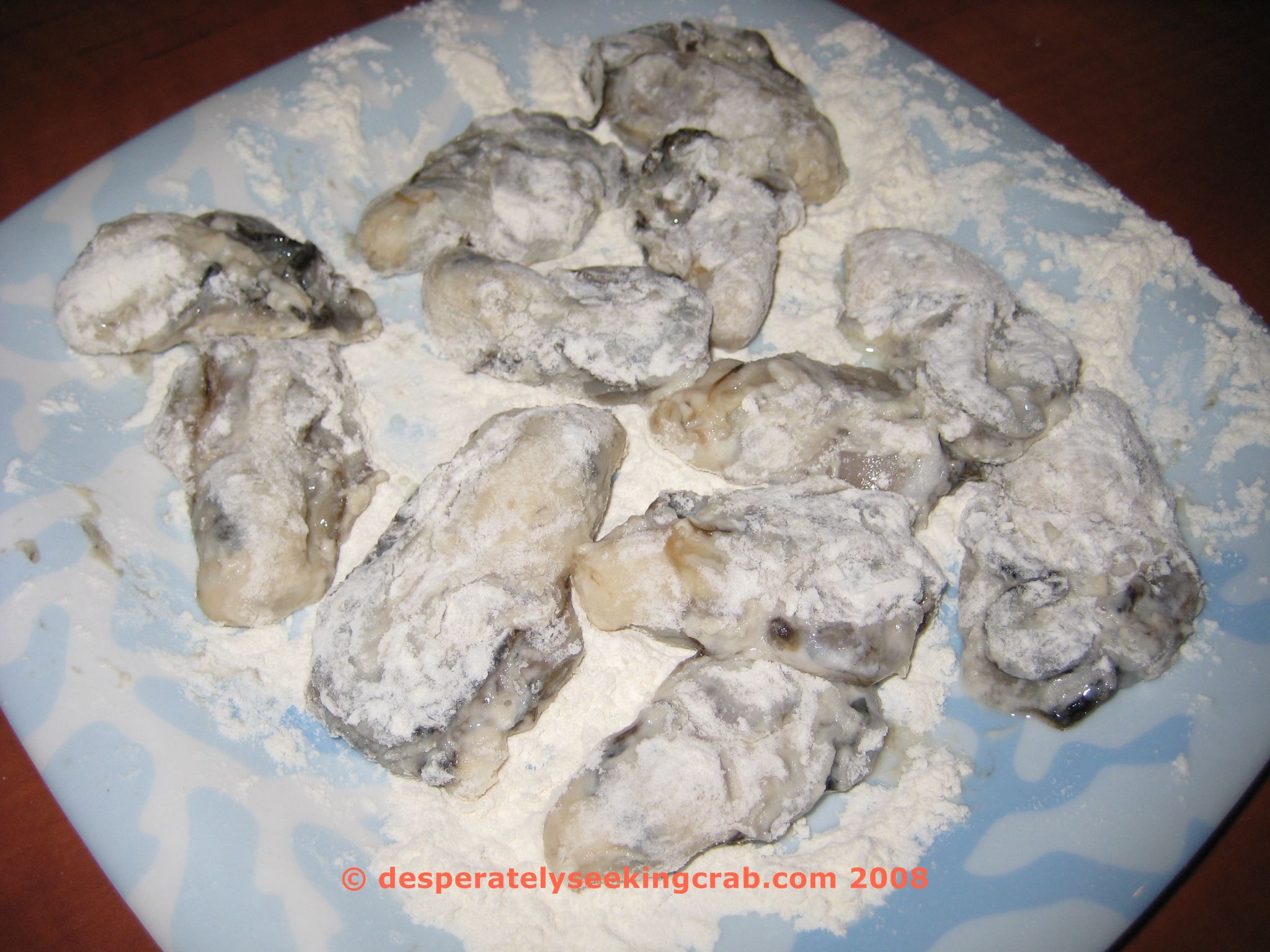
Season the oysters with a little salt and pepper.  Then get yourself situated so that the closest plate to the hot oil is the panko, then the egg, then the flour.  Roll as many oysters as you can into the flour to coat and before dunking them into the egg, dust off excess flour.  Once coated with egg, dip them immediately into the panko and dunk straight into the hot oil.  If you start running out of flour, egg or panko before finishing all the oysters, just simply add more to finish off.

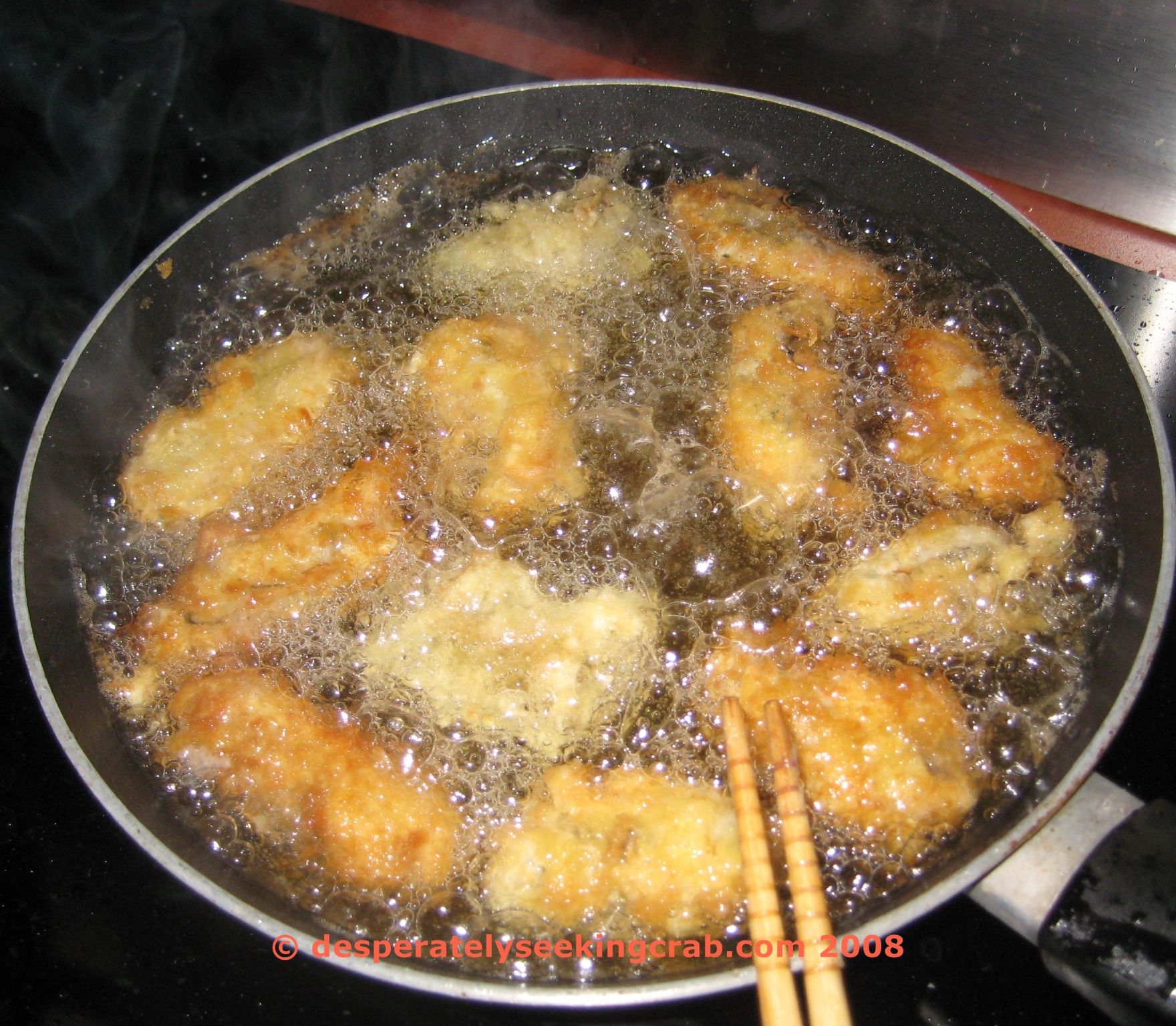
If using a deep-fat fryer, fry until golden brown.  If using a shallow fry-pan, let oysters become golden brown on one side and turn over with cooking chopsticks or tongs until both sides are golden brown.  Let drain on paper towels. Serve with Japanese tonkatsu sauce and hot Japanese white rice.  I like to have miso soup with this as well to round it off to a complete meal.  🙂

Here is a link to another version of this dish from about.com:

http://japanesefood.about.com/od/seaweed/r/friedoyster.htm
Shredded Cabbage & Cucumber as Accompaniment to Oysters

Shredded Cabbage & Cucumber as Accompaniment to Oysters

Oysters Dusted in Flour Ready for the Egg

Oysters Dusted in Flour Ready for the Egg

Oysters Frying in Oil
Oysters Frying in Oil

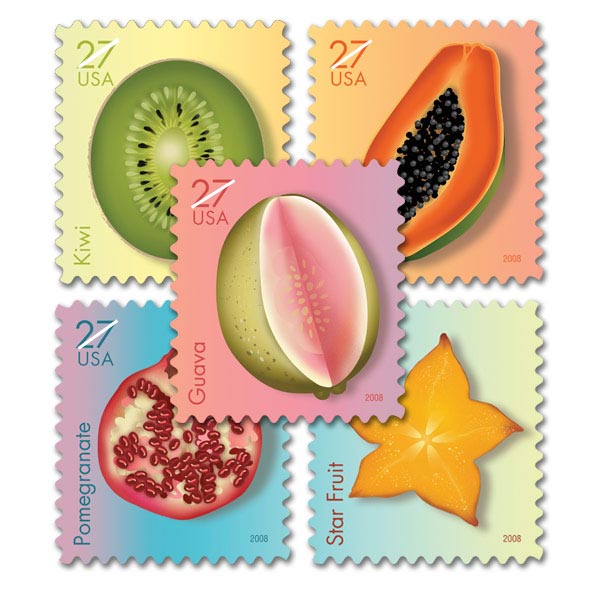
U.S.P.S. "Tropical Stamps" Set

U.S.P.S. "Tropical Stamps" Set

I received a package from my friend in San Francisco a few weeks back and normally I don’t take much notice to the stamps on the envelope but this time, I noticed that the stamp looked like a picture of something edible and it was!  I couldn’t believe my eyes – it was a guava stamp!  Surprised to see one of my favorite fruits on a stamp, I looked up the specifics.

Seems that the United States Postal Service (USPS) issued a 27 cent postcard stamp set called “Tropical Stamps” on 25 April 2008.  It comprises of five beautifully illustrated stamps by Cuban-born artist Sergio Baradat and was revealed at the WESTPEX Stamp Show in San Francisco.  I have to admit, they are very aesthetically pleasing but here is what I DON’T get.  According to the press U.S.P.S. press release:

Baradat created art that visually slices or halves five tropical fruits – pomegranate, kiwi, star fruit*, papaya and guava – depicting them in eye-catching and mouth watering color.

OK, correct me if I’m wrong but last time I checked, pomegranates and kiwis are NOT tropical fruit – they may be “exotic” but tropical they are not – I know my tropical fruit!  I remember seeing guava trees growing wild all over the rainforest and papayas and starfruit in people’s yards.  I know that pomegranate trees can technically grow in the tropics but they don’t tend to get that really dark deep red and they definitely don’t thrive.  According to the California Rare Fruit Growers:

Pomegranates prefer a semi-arid mild-temperate to subtropical climate and are naturally adapted to regions with cool winters and hot summers.  A humid climate adversely affects the formation of fruit.

There you go, they don’t like humidity and do best in areas with cool winters and hot summers – i.e. anywhere with a “Mediterranean” climate – like in southern France, Adelaide, Melbourne, Sacramento Valley, Napa Valley…you get the idea.

As for kiwis, it is a native of China, from the Yangtze River valley of northern China and Zhejiang Province on the coast of eastern China.  Their seeds were taken out of China to New Zealand by missionaries and surprisingly today, Italy is the country that produces the most Kiwifruit in the world!  Kiwis grow best in areas where citrus and stone fruit grow and depending upon the cultivar, their needs vary dramatically but what’s certain is that kiwis need a certain period of winter chilling (for dormancy).

Although very pretty, I would honestly LOVE to find out who chose the fruits for the “tropical” stamps collection and why they chose the pomegranate and kiwi to be included!

*Starfruit is also known as Carambola and PLEASE don’t eat it if it’s green because it is not ripe!  I have seen some appaulling examples of starfruit sold at the supermarket.  I can just imagine someone who is curious to eat a starfruit and buys a green one and because they taste so horrible, thus writes them off for life!  Starfruit should be eaten when it’s a deep yellow color (when they are sweet and fragrant) and often when the outside edges (star tips) start to brown (as you see in the stamp illustration).  Those with kidney problems, gout or rheumatoid arthritis should avoid eating it due to its high level of oxalic acid.

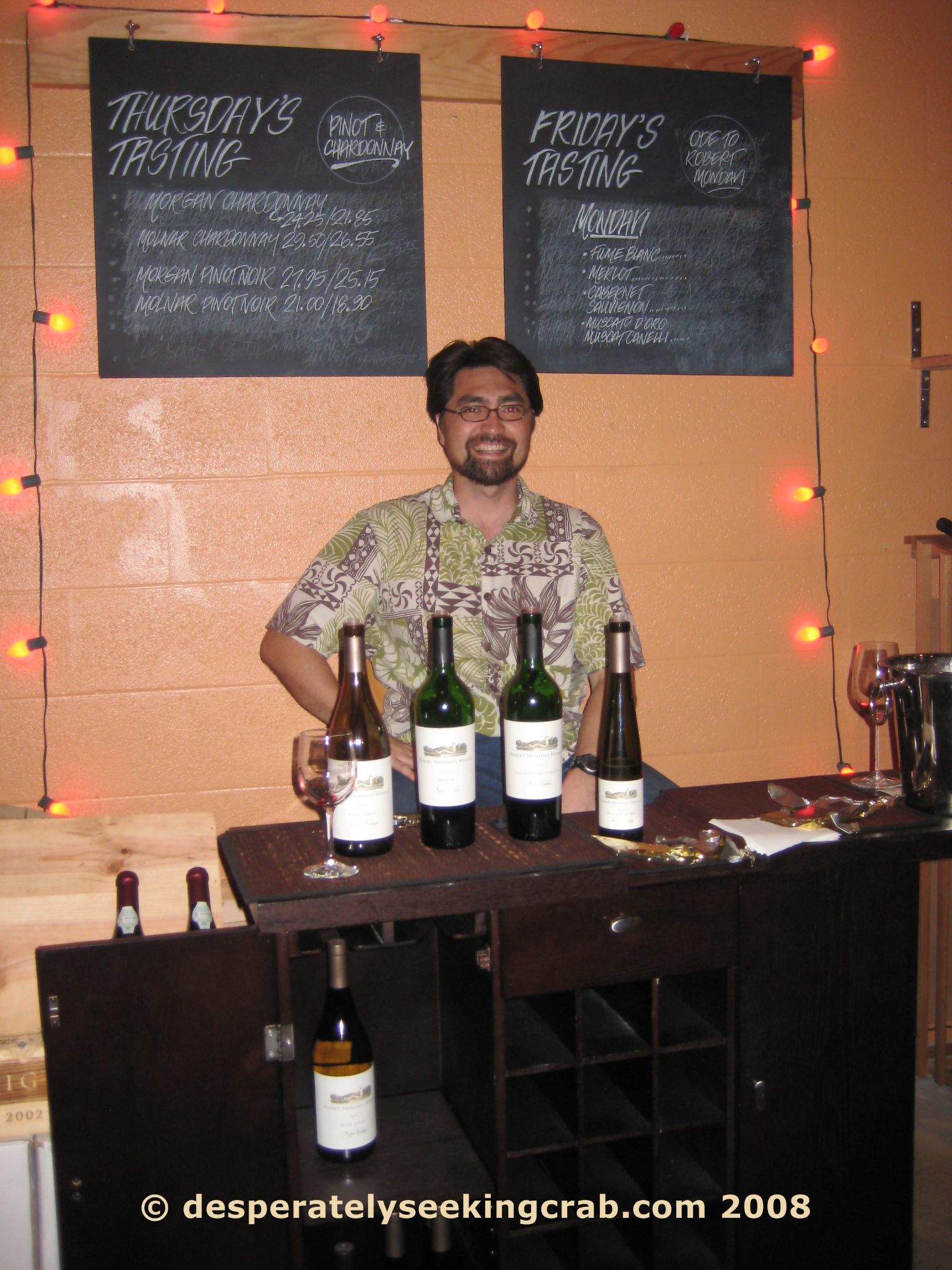
Andre Lopez on Tasting Night

Andre Lopez on Tasting Night

Susan (looking shy) and Andre's Mother

When I was much younger, the only decent wine shop in Hawaii was R. Field in Ward Centre and most of the selections at the local supermarkets were pretty abysmal.  Fast forward 20 years and Hawaii’s wine retail scene has become infinitely better with many decent wine shops and wine bars – even the new Safeway on Kapahulu Ave. has a huge (slightly overpriced) wine section.  I have been to just about all but I think one of these wine establishments on Oahu and my favorite place so far is The People’s Wine Shop on S. King St, just past the vacuum specialist shop on the corner of Pensacola and S. King St. (near Kaiser) in the King Street Apartment Hotel (ample parking on the street and in the back).  As soon as you see the vacuum shop, you have to slow down because there is no awning displaying the shop’s name but there is there is a simple bright neon sign that let’s you know where the shop is.

If any of you are familiar at all with Berkeley, California, The People’s Wine Shop reminds me a bit of Vintage Berkeley (around the corner from Chez Panisse) because of the small size, personalized service and interesting selections.  But The People’s Wine Shop has more of a welcoming feeling and I wonder if that has to do with the fact that it’s painted a warmer color or whether there is a lot of aloha spirit there.

I first met Andre at a trade wine tasting event at the Hilton sometime late last year and although we didn’t really talk to each other, I recognized him because we were often at the same tables tasting wines.  It wasn’t until I went to his shop that I realized that he was the owner!  I knew I’d like his shop because we must have had similar tastes to be at the same vendors.

The store, which opened in 2006, is run by Andre and Susan (who are always there with a smile) and his Friday and Saturday night free tastings are becoming very popular with local wine lovers.  He features a different winery/producer/supplier every week and gives a discount on the featured wine as well.  I love that he has harder to find wines from all over the world and with a really great Spanish and Italian section and best of all, the wines he brings in won’t break your bank!  Andre stocks more premium “collector” wines as well but he prides himself on making wines approachable to everyone.  I love the anti-snob quality there and because they’re so warm and friendly, they already have a big following of regular customers.  I have run into people I know there and nearly everyone who comes on tasting nights seem to be known by name.  Recently when I stopped by, he was tasting Mondavi wines to pay tribute to Robert Mondavi, shortly after his passing and that definitely touched me since I feel so connected to that place.

I wished this shop was around when I got married because it would’ve been great to purchase wine from him but alas, I bought it from another shop who barely gave me a smile.  Whether you are a wine geek or wine novice, Andre’s shop is a great stop to buy some interesting wines in Hawaii.

**If you are a tourist and have a rental car, this shop is only about 4 miles away – which should take about 20 minutes (depending on traffic) from most Waikiki hotels.

**UPDATE: This store has closed its doors.** 😦

Design a site like this with WordPress.com
Get started